

Charms magic can be used to move objects in various ways.
Locomotion Magic
The basic spell for moving an object is Locomotor, which comes from two Latin words meaning roughly “move from its place.” First years learn to move objects by magic; the practical part of Flitwick’s exam for the first years consisted of their being able to make a pineapple dance across a desk.
The Locomotion spell words are often said with a target, so for example when Flitwick transported Trelawney’s belongings back up to her rooms, he said “Locomotor trunks!”, then directed them up the staircase with his wand.
Another spell word used to move things is Mobili. This is also from Latin and means active or moveable. This spell word is frequently combined with other Latin words to create incantations like Mobilicorpus to move a body or Mobiliarbus to move a tree. The effect of this spell is very similar to the Locomotion spell.
Flying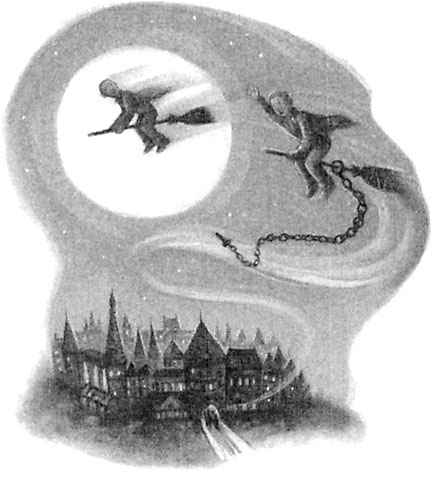
It is not possible for people to make themselves fly unaided by magic. Unless a wizard is an Animagus who transforms into a flying animal, therefore, he or she must enchant some other object to fly and then ride along (QA1). There are a number of ways for this to happen. The basic form of flying is Levitation, for which the spell words are Wingardium Leviosa. The word Leviosa comes from Latin and means “to levitate,” but wingardium is not Latin, since that language does not use the letter W. Possibly the Wingardium comes from the English word “wing,” which has obvious connections to the idea of flying. It is also possible that since first years start their Levitation training using feathers, the Wingardium is a Latinized version of an object or target word. Another version of Levitation is the Hover Charm which has an effect very similar to the Levitation spell. It is possible that Hover Charm is another name it.
More advanced forms of flying enchantments are used to make broomsticks, carpets, motorcycles, and even Ford Anglia automobiles fly. The spell words for this are not given, but these spells are very common, especially the broomstick variety.
Summoning
A more advanced form of movement is Summoning. When a wizard or witch Summons an object, it comes flying through the air to the caster. It will even break through barriers or break chains in order to obey the summons, although this may depend on the power of the spell caster. The incantation for this is Accio, which comes from the Latin word for “summon.” While the original Latin pronunciation of this word would be “AK-see-oh,” most people pronouce the incantation as “AS-ee-oh.” Either way, the spell word can be combined with a target word or can be used alone with intention filling in the required information.
The opposite of Summoning is Banishment. When an object is Banished, it flies away from the spell caster. The spell words for this are not given.
Other movement spells
A number of other spells move things around, often in very specialized ways. An example of this type of specialty spell is the “pack” spell that Tonks used to put Harry’s belongings in his trunk. She mentions that her mother’s version of the spell actually matched up the socks, but hers wasn’t that clever. The Disarming Charm is designed specifically to remove a person’s weapon, which often means that the person’s wand goes flying. The spell word for this charm is Expelliarmus, which comes from two Latin words meaning “to expel a weapon.” The Hurling Hex can make brooms try to buck or throw their riders. The Reparo spell, which can be used to repair almost anything, physically moves the broken pieces back together again. Finally, Hagrid used a spell of some kind to propel the rowboat through the water back to the mainland when he rescued Harry from the Hut-on-the-Rock. Perhaps he uses that same spell on the fleet of little boats he takes the first years across the lake in.
Some curses force a person to move. Tarantallegra makes the victim dance while the Tickling Charm, spell word Rictusempra, forces them to laugh. The Jelly-Legs Jinx makes a person’s legs wiggle uncontrollably.
Spells that inhibit movement
While the Banishment Charm has an opposite effect from the Summoning Charm, both make an object move. Some spells, however, inhibit or prevent movement. The Braking Charm, employed on some racing broomsticks, slows the movement of the broom. A person can be affected by spells that bind the legs together (the Leg Locker Curse, spell words Locomotor Mortis) or freeze the entire body (the Full Body Bind, spell words Petrificus Totalus). A Freezing Charm was once used by Hermione to stop a couple of Pixies in their tracks afterLockhart released a bunch of them in class (no, she didn’t freeze the whole room full of them, as it shows in CS/f). And the Impediment Jinx, spell word Impedimenta, can block someone or something from moving toward the caster. The Trip Jinx doesn’t stop movement so much as interfere with it. A person affected trips and falls, sometimes quite spectacularly.
Commentary
Notes
Added links.
Pensieve (Comments)
Tags: flying